Bay Wars: The Unwritten Rules of Britain's Public Charging Etiquette
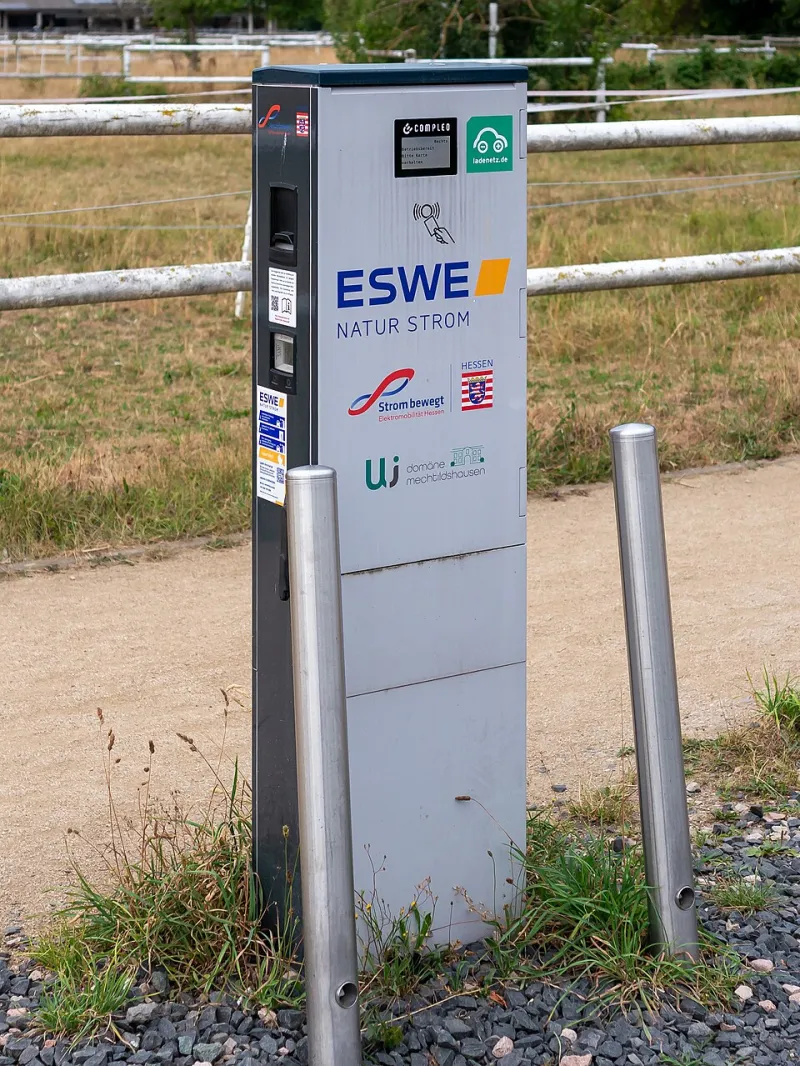
Photo: Matti Blume, CC BY-SA 4.0, via Wikimedia Commons
It's 7.40pm on a Friday in November. You've got 14% battery, a six-year-old in the back asking why the lights are orange, and you've just pulled into a motorway services where four of six charge bays are occupied, one contains a diesel estate with no cable in sight, and the sixth is being circled by a Nissan driver with the look of a man who has been here since lunchtime.
Welcome to the frontline. Public charging in Britain has improved enormously on paper — contactless payment is now standard on new rapid units, reliability standards are enforced, and pricing has to be displayed clearly. In practice, the hardware was never the hard part. We are. Here's the etiquette code nobody printed on the bay markings.
First, the honest state of play
The regulatory groundwork has done real good. New rapid chargers have to take contactless, publish their prices per kWh, run a 24/7 helpline and hit reliability targets. Networks have largely cleaned up their act, and the days of arriving at a bank of six units with two working and no phone signal are — mostly — behind us.
What hasn't been fixed is the queue. There is no physical queue. There is only a loose arrangement of cars, hazards, hopeful glances and quiet British resentment. That's the entire problem.
Rule one: the hover is not a queue
If you arrive and all bays are full, park somewhere legal, walk over, and ask who's waiting. Actually ask. A five-second conversation saves twenty minutes of passive-aggressive windscreen staring. If you're the one charging, tell people roughly how long you'll be. If your car is at 91% and there's a queue, say so out loud — it buys a surprising amount of goodwill.
And please: don't occupy a charging bay while you queue for it. That's the move that turns a mild inconvenience into a group therapy session.
Rule two: never unplug a stranger
Tempting. Understandable. Nearly always wrong. The only defensible exceptions are a clearly signed sharing bay, or a car that's finished charging and left a note saying so. Anything else is someone's locked cable and someone's anger. If a car is genuinely finished and blocking a needed bay, use the helpline or the network app rather than your own judgement — and photograph the state of play before you touch anything.
Rule three: 80% is the social contract on rapids
On a 150kW charger, your car will slow to a crawl past roughly four-fifths full. That's not the network being unkind, it's chemistry. Sitting at 99% on a busy rapid is the EV equivalent of doing a weekly shop in a petrol forecourt bay: technically permitted, socially frowned upon.
If you need a full charge, use a slower unit, charge overnight, or pick a rapid site with plenty of spare bays. On a Sunday afternoon at a motorway services, take the 20 minutes and move along.
Rule four: shared posts are a dance, not a fight
Two-socket destination posts — the sort you find at hotels, retail parks and leisure centres — are where the real confusion lives. Cable reach is the perennial issue, so park thoughtfully: nose-in, cable routed without crossing a walkway, and please don't drape it through a hedge.
If someone's cable is already plugged into the shared post and reaching awkwardly, ask before you add yours. It's usually fine. Occasionally it's a fused supply and one of you is about to find out the hard way.
Rule five: idle fees are your friend
Every driver hates paying to sit still. But idle fees are the single most effective tool we have against bay-blocking, and they only work if everyone accepts them as the price of courtesy. Set a timer when you plug in. Walk away. Come back. Move the car.
The corollary: if a car is finished and accruing fees, its owner is already having a worse day than you. Be the person who leaves a polite note rather than the person who films it for social media.
Rule six: assume every app will fail
In 2026 this remains the most reliable prediction in motoring. Networks do go down, mobile signal does vanish behind a service station, and that one app you haven't updated since March will pick the worst possible moment to demand a login.
So: carry an RFID card or two, know which networks take contactless, screenshot your charging session once it starts, and keep a backup payment method. If a session fails to start but the bay is live, don't keep tapping like it's a dodgy ticket machine — ring the helpline number displayed on the unit, because it's a regulatory requirement that someone answers.
Rule seven: the motorway services standoff
Peak times are predictable. Friday evenings, Sunday afternoons, bank holiday weekends and the great Christmas exodus. If you're planning a long run, arrive with more than you need and treat the services as a top-up rather than a lifeline.
Better still, look one junction along. Retail park rapids, supermarket hubs, hotel chargers and dedicated electric forecourts are often quieter, cheaper and better lit than the flagship motorway site everyone defaults to. Ten minutes of planning in the warm, at home, beats 30 minutes of negotiating in the rain.
The Auto Vista charging code
- Ask, out loud, who's waiting.
- Never unplug a car without permission.
- Move off a rapid once you're past 80% if anyone's queuing.
- Leave a note if you're sharing a post or running late.
- Set an idle-fee timer the second you plug in.
- Carry a card, a backup app and a screenshot.
- Don't block traffic lanes to hold a bay.
- Assume the person in front of you has had a worse day.
Kit that earns you goodwill
A decent Type 2 cable you actually know how to coil, a couple of network RFID cards, a printed 'back in 20 minutes' card for the windscreen, and a small torch. That's it. No need for a boot full of adaptors you'll never use.
Final word
Britain's charging network is no longer the Wild West. It's more like a busy car park with very expensive bollards and no markings for common sense. The infrastructure will keep improving, but the etiquette is ours to write — and honestly, a nation that can form an orderly queue for a bus can manage this.